This article takes a closer look at the anatomy and function of the supraorbital nerve, along with the causes of supraorbital nerve pain and potential treatment options.
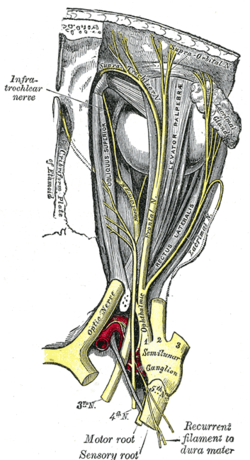
It exits the orbit via the supraorbital foramen/notch before splitting into a medial branch and a lateral branch. It innervates the skin of the forehead, upper eyelid, and the root of the nose.
The supraorbital nerve is a nerve of the head and neck region. It is the largest branch of the frontal nerve and supplies the skin of the forehead and scalp.
Supraorbital Nerve The supraorbital nerve is the larger of the two terminal branches of the frontal nerve and is the principal cutaneous branch of CN V1.
The supraorbital nerve is a sensory nerve that conveys general sensation from the skin of the forehead, frontal sinus, skin of the upper eyelid, and conjunctiva of the upper eyelid and eyeball.
Background Anterior view of the right orbit. The supraorbital nerve can be seen exiting the orbit through the supraorbital notch with the supraorbital artery.
The exit points of the supraorbital nerve and its branches hold significant importance in various medical procedures, including supraorbital endoscopic surgeries, forehead–facial aesthetic plastic surgeries, medical aesthetic applications and maxillofacial surgeries.
The supraorbital nerve block is often used to accomplish regional anesthesia of the face because it offers several advantages over local tissue infiltration. A nerve block often achieves...
The supraorbital nerve bifurcates either just before or after passing through the supraorbital foramen and it gives off the medial and lateral branches of the supraorbital nerve. The supraorbital nerve conveys sensation from the skin of the forehead, frontal sinus, and skin of the upper eyelid.